How Ample finds Moves
Four scanners run over your synced data: recurring charges, debt, savings yield, and the mortgage. What each looks for, what it needs to be sure, and what it will never claim.
Updated September 5, 2026 · 3 min read
A Move is a concrete, dollar-labeled way to save money or improve cash flow that Ample found in your own data. Every Move shows the arithmetic behind it, because a number you can argue with is worth more than one you have to trust. Here is what looks for them.
The four scanners
Recurring charges. Every charge that repeats on a roughly monthly, quarterly or annual cadence is tracked against its own recent median. A charge that comes in above that median for three bills in a row is a price creep Move, with the old amount, the new amount and the percentage. A subscription that keeps charging with nothing in your data suggesting it is used is flagged for review as a possible zombie; that one never claims a saving on its own, because the data cannot know whether you use it.
Debt. Card balances against limits and statement close dates produce utilization timing Moves: "pay $787 to this card before the 17th to report at 30%." The payoff planner produces payoff order Moves (avalanche or snowball, with the interest saved against minimums). When a consolidation or balance-transfer route would cost less in total, that appears too, with the full cost laid out. See Debt consolidation Moves and how offers are shown.
Savings yield. Your savings balances, weighted by size, against the best widely available insured rate. If the gap is more than a small threshold, the Move shows the gap in points and in dollars a year. The rate it compares against is looked up when the scan runs and named on the card.
Mortgage. First-lien loan-to-value against the value Ample holds for your home. At or near 80% it proposes PMI removal with the yearly saving and drafts the letter. It also runs a refinance check on a principal-and-interest basis with closing costs included, and only proposes one when the break-even is inside a horizon you set.
When scans run
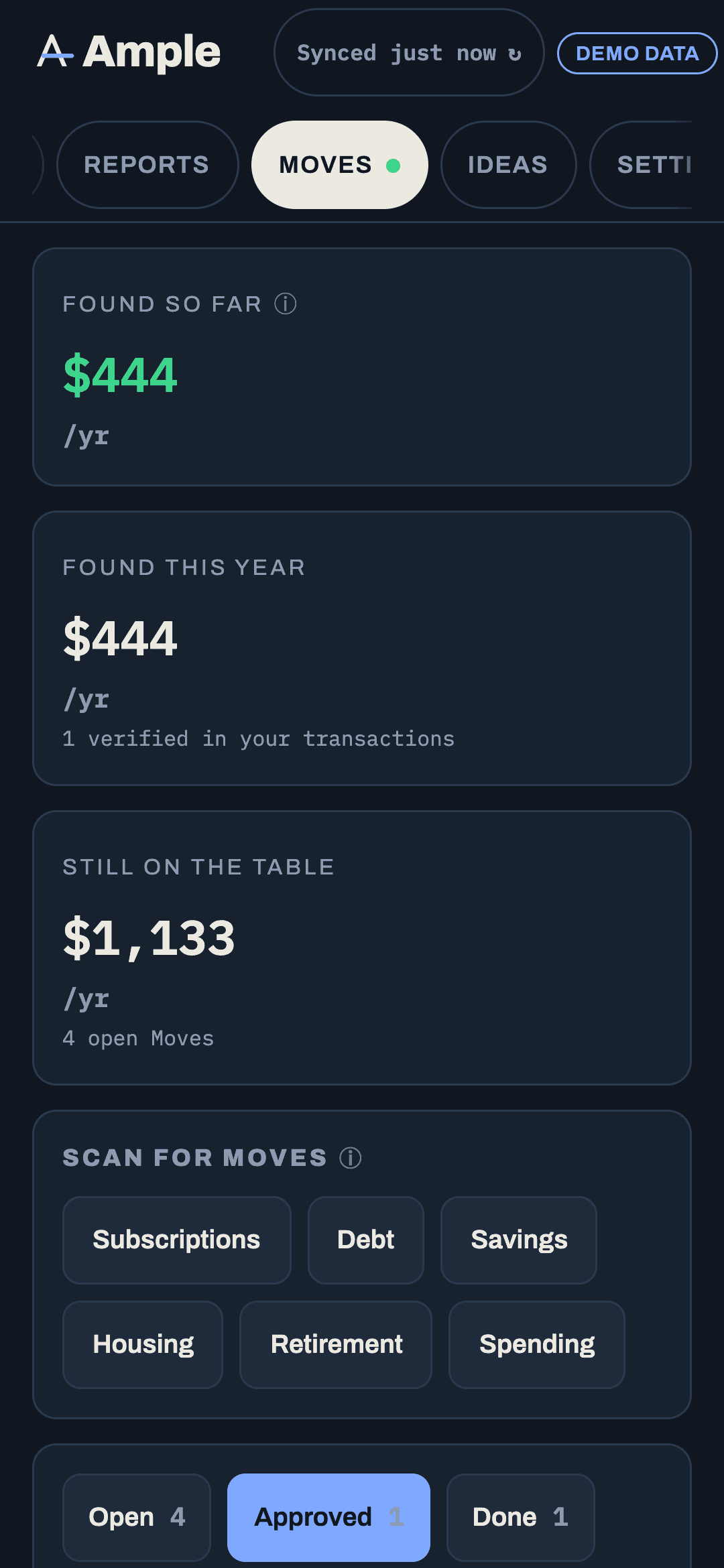
Recurring charges are scanned weekly; debt, savings and mortgage monthly; and any scanner can be run now from the Moves page with Scan now. A Move that is already on the list is updated, not duplicated. A Move whose facts changed (the charge went back down, the balance dropped) is retired automatically with a note.
Ranking
Moves are ordered by your dollars: monthly impact first, then one-time impact. Nothing else affects the order. Ample takes no fee or referral from any product a Move might mention, so a $70-a-year savings Move sits below a $27-a-month utility one and both sit below a $233-a-month PMI one, exactly as the arithmetic says.
Statuses
New is fresh. Reviewing means you have opened it and are thinking. Done means you approved it and the outcome happened. Dismissed means no; Ample remembers and will not raise the same Move again unless its numbers change materially.
What a Move will never do
It will never move your money. It will never assume something it cannot see in the data (usage of a subscription, your reasons for a balance). It will never hide the math. And where a Move relies on a fact from outside your accounts (a current rate, an offer), it carries a verify-before-acting note that says where the fact came from and asks you to confirm it before you act.
More in Moves
Still stuck?
Tell us what you were trying to do and what happened. A person reads every message.
Contact support